Are AI calorie counter apps accurate?
Key points
- A systematic review of 52 studies found AI image-based calorie errors ranging from about 0.1 percent to 38 percent, and lower when meals were simple.
- On 200 lab-weighed meals from the Nutrition5k dataset, our photo model's median calorie error was roughly 27 to 33 percent, with a tendency to overestimate.
- Photo estimates are good for trends over days and weeks, and weaker for the exact calories of one meal.
- Weigh food or scan a barcode when you need precision, and ask a clinician when the number matters medically.
Apps that estimate calories from a photograph are popular because they remove most of the effort of logging. The honest question is how close they get. We make one of these apps, so we will say up front where our evidence comes from and where it ends.
What published research says
A 2023 systematic review in Annals of Medicine (Shonkoff and colleagues, Tufts University) searched the literature through May 2023 for studies in which fully automated AI methods estimated volume, energy or nutrients from food images and compared them with a ground truth or with human assessors. It kept 52 studies. Key findings:
- Average relative errors for calories ranged from 0.10 percent to 38.3 percent, and for volume from 0.09 percent to 33 percent.
- Errors were lower when images contained single or simple foods.
- The studies differed so much in image databases and reporting that the authors could not combine them statistically.
- The authors concluded that AI methods align with, and have the potential to exceed, the accuracy of human estimates. They also note that human error in estimating food intake is a major source of bias in nutrition research.
Two points are worth taking from this. The spread is wide: some systems in some conditions are very accurate, and others are not. And the comparison that matters is not AI against perfection, but AI against the alternative, which for most people is guessing from memory.
What we measured
We benchmarked SnapMacro's photo model on 200 meals from Nutrition5k, a Google Research dataset of real cafeteria dishes in which each ingredient was weighed as it was added to the plate, so the calorie and macro values are measured rather than estimated (Thames et al., CVPR 2021). Results:
| Test | Result |
|---|---|
| Photo model, 200 meals, calories | Median error roughly 27 to 33 percent across runs |
| Direction of error | Tendency to overestimate, about 21 percent on average |
| Depth study, plate-referenced volume estimate, same dataset | About 26 percent median error |
| Depth study, same subset, photo model | About 35 percent median error |
Caveats matter. These are cafeteria plates photographed under controlled conditions, which is not the same as a restaurant meal or a packed lunch. The depth comparison was a study on one subset of one dataset; SnapMacro uses an ordinary photo, not a depth sensor. The full write-up is on our accuracy page.
Why photos are hard
- Hidden fat. Oil, butter and dressings soak into food and are almost invisible. A tablespoon of olive oil is about 119 kcal by USDA data, which is a large amount to miss. See hidden calories in cooking oil and sauces.
- Portion depth. A flat image does not show how deep a pile of rice or pasta is. In the depth comparison above, the version that used volume information was closer, which points at portion size as the hardest part.
- Hidden ingredients. Burritos, casseroles and smoothies conceal what is inside.
- Database variation. Even a perfectly identified food has a range. A homemade lasagna and a restaurant one are different foods.
Why a 30 percent error can still be useful
An error of that size sounds large, but two things soften it. First, errors in both directions partly cancel across many meals. Second, a consistent bias, such as a tendency to overestimate, is less damaging to trend-based decisions than random noise, because you can calibrate against your weight trend. If your logs say you ate 2,000 kcal a day and your weight is stable, then 2,000 kcal in the app is your maintenance in practice, whatever the true figure.
It is not a reason to relax about everything. For someone targeting a small deficit, a systematic error of 20 percent on a 2,000 kcal day is 400 kcal, which could be the whole deficit. That is why a feedback loop based on weight (see adaptive TDEE) matters more than any single estimate.
How to get closer
- Photograph at about 45 degrees and include the whole plate so size can be judged.
- Add what the camera cannot see: cooking oil, sauce, dressing, butter.
- Scan barcodes on packaged food. A label is more reliable than any photo.
- Edit the result. A wrong item or portion is a ten-second fix.
- Weigh the foods you eat often. Doing it for a week teaches your eye.
- Judge the weekly average, not one meal.
When not to rely on photo estimates
If you must know an exact amount for a medical reason, such as managing diabetes, kidney disease or an eating disorder recovery plan, weigh food and ask your clinician or registered dietitian. No consumer app should replace that.
How SnapMacro helps
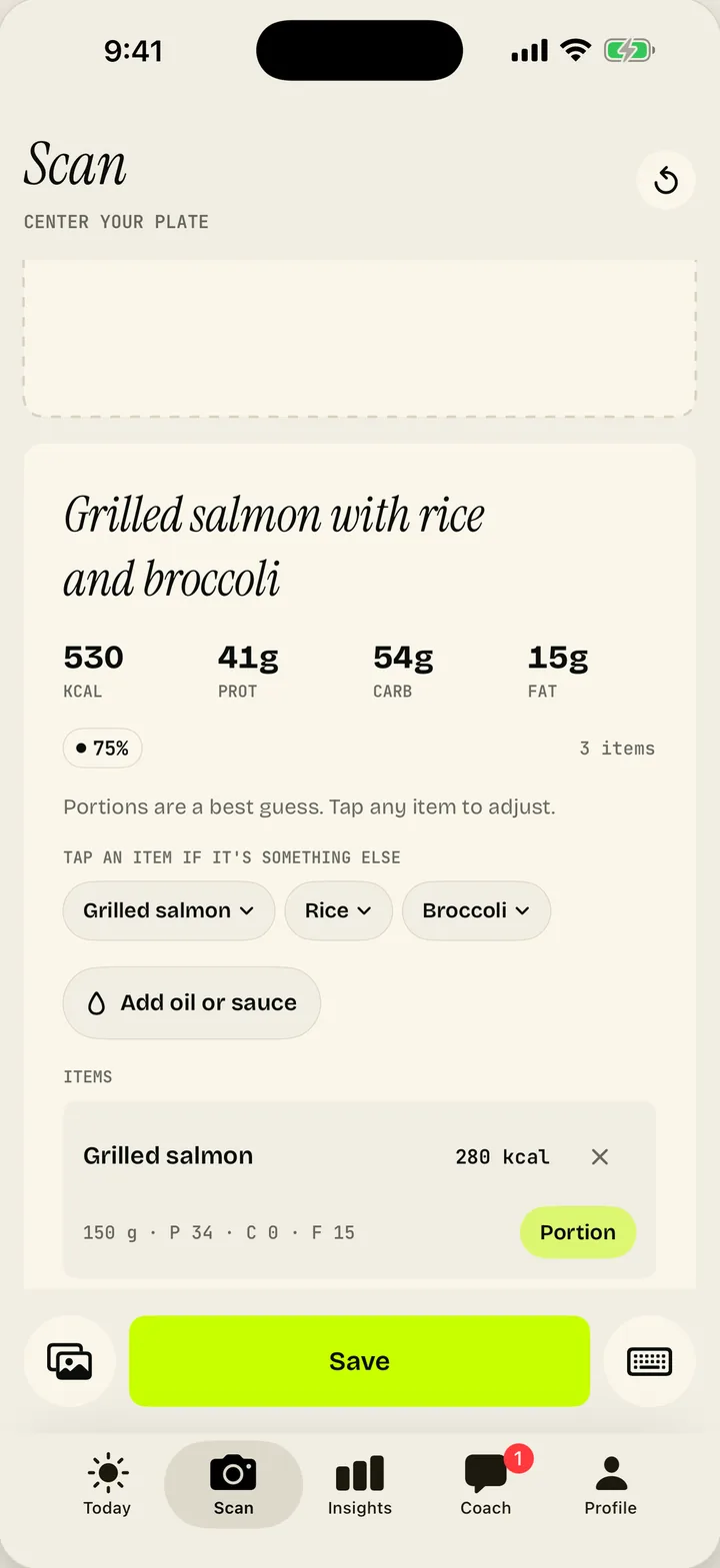
SnapMacro estimates calories and macros from a photo, shows a confidence note when the model is unsure, and makes every item, portion and the dish name editable. You can swap a wrongly identified food, add hidden oil or sauce, scan a barcode for packaged food, or log by text or voice. It is designed to give a record that is close enough over enough days for your weight trend to tell the truth, not a perfect number at every meal. For targets, try the TDEE calculator and the protein calculator.
General information only. SnapMacro is not a medical device and photo estimates are estimates.
Sources
- Shonkoff E, Cara KC, Pei XA, Chung M, Kamath S, Panetta K, Hennessy E. AI-based digital image dietary assessment methods compared to humans and ground truth: a systematic review. Ann Med. 2023;55(2):2273497. PubMed
- Thames Q, Karpur A, Norris W, Xia F, Panait L, Weyand T, Sim J. Nutrition5k: Towards automatic nutritional understanding of generic food. CVPR 2021. CVF Open Access
- USDA FoodData Central, Oil, olive, salad or cooking (FDC ID 171413). fdc.nal.usda.gov
- SnapMacro. How accurate are AI calorie counters? snapmacroapp.com/accuracy
SnapMacro
Skip the counting
Snap a photo of a meal and SnapMacro estimates the calories and macros. Every item is editable, and your targets adapt to your real weight trend.
Download on the App Store