Hidden calories in cooking oil, sauces and dressings
Key points
- Cooking oils are about 880 kcal per 100 g, so one tablespoon (about 13.5 g) of olive oil is roughly 119 kcal.
- Oil, butter and dressing are the most common reasons logged calories fall short of reality, because they are hard to see and easy to pour.
- Many dressings and mayonnaise-based sauces provide 70 to 160 kcal per two tablespoons.
- Measuring fat once, with a spoon or a scale, is more useful than any other single logging habit.
- Fat is not bad. It is just dense, and worth counting.
The most common gap between what people log and what they eat is not the main course. It is the fat added around it. Oil is nearly pure fat, fat contains about 9 kcal per gram, and a small pour is a large number of calories. This article lists USDA values for common cooking fats and sauces so you can see the scale.
Why fat is easy to miss
When you cook vegetables, rice or eggs in oil, the fat soaks in or coats the surface. Looking at the plate afterwards, you cannot tell whether there was a teaspoon or three tablespoons. That limits any estimate based on appearance, including our own photo model; see how accurate AI calorie counters are. In the Nutrition5k dataset used for our benchmark, every ingredient was weighed as it was added, which is exactly the information a camera does not have.
What common fats and sauces contain
Values are from USDA FoodData Central (SR Legacy), per 100 g, with portions calculated by us from typical weights. Portion weights are approximate, and brands differ, especially for dressings.
| Food | kcal per 100 g | Portion | Approx. kcal per portion | FDC ID |
|---|---|---|---|---|
| Olive oil | 884 | 1 tbsp (13.5 g) | 119 | 171413 |
| Coconut oil | 892 | 1 tbsp (13.6 g) | 121 | 171412 |
| Butter, salted | 717 | 1 tbsp (14.2 g) | 102 | 173410 |
| Mayonnaise, regular | 680 | 1 tbsp (13.8 g) | 94 | 171009 |
| Heavy whipping cream | 340 | 1 tbsp (15 g) | 51 | 170859 |
| Caesar dressing, regular | 542 | 2 tbsp (30 g) | 163 | 169055 |
| Blue cheese dressing, regular | 484 | 2 tbsp (30 g) | 145 | 173562 |
| Ranch dressing, regular | 430 | 2 tbsp (30 g) | 129 | 173592 |
| Italian dressing, regular | 240 | 2 tbsp (30 g) | 72 | 171019 |
| Spaghetti/marinara sauce | 50 | 1/2 cup (125 g) | 62 | 171192 |
| Barbecue sauce | 172 | 2 tbsp (36 g) | 62 | 174523 |
| Ketchup | 101 | 2 tbsp (34 g) | 34 | 168556 |
Two patterns stand out. First, pure fats such as oil and butter are around 100 to 120 kcal per tablespoon, so a heavy-handed pour of three tablespoons is more than 350 kcal. Second, sauces vary widely: tomato-based and sugar-based sauces are mostly lower in calories per serving than creamy ones, but the serving in a bowl is usually larger than the two tablespoons used on labels.
Three everyday scenarios
A stir-fry
Chicken, vegetables and rice are easy to estimate. If the pan got two tablespoons of olive oil and only half stayed in the pan, the food may still hold roughly 120 kcal of oil, with the exact amount depending on how it was cooked. Logging one tablespoon is a reasonable compromise when you cannot measure what was left behind.
A salad
Leaves and vegetables are low in calories. A restaurant or deli salad can reach several hundred more with dressing, cheese, nuts and croutons. If the dressing arrives poured over, you cannot see how much there is. Asking for it on the side lets you decide.
Roasted vegetables
Vegetables roasted with a "drizzle" of oil often receive one to two tablespoons for a tray. Divide by the number of servings and the oil per serving is modest, but it is not zero.
How to count fat without turning cooking into a chore
- Measure it for a week. Use a tablespoon, or put the pan on a scale and weigh the oil by grams. Afterwards you will be able to judge what a "normal pour" is for you.
- Use a spray or brush for pans where you only need a thin film.
- Measure into the pan, not over it. Pouring from the bottle is the main source of error.
- Put dressings on the side and dip or spoon rather than pour.
- Log oil as its own item so it does not get lost inside a dish.
- Check restaurant food generously. Restaurant kitchens may use more fat than home cooks, but we do not have a measured figure to quote, so when an estimate matters, assume the higher end of a range.
Is this a reason to avoid fat?
No. Fat is part of a normal diet, helps with satiety and flavour, and carries fat-soluble vitamins. The National Academies' Acceptable Macronutrient Distribution Range for fat in adults is 20 to 35 percent of calories. The point is only that it is the most calorie-dense thing on your plate, so a small amount of uncounted fat has an outsize effect. For more on how macros and calories relate, see how to count macros.
Why it matters for your plan
Suppose you are aiming for a 300 kcal daily deficit. If three uncounted tablespoons of oil, butter or dressing sneak in each day, the deficit disappears. This is a frequent reason for stalled progress. See calorie deficit explained.
How SnapMacro helps
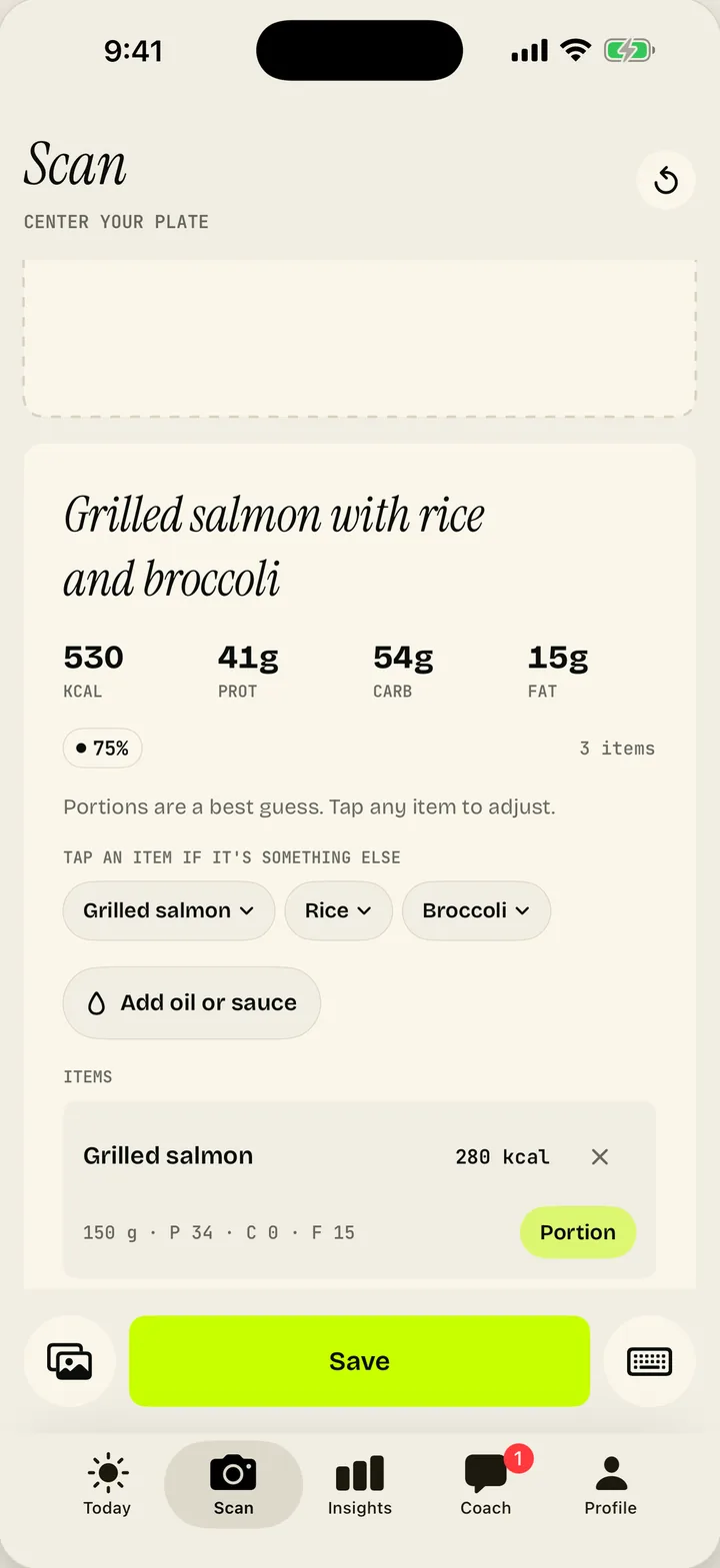
A camera cannot see oil, so SnapMacro lets you add cooking fat or sauce to a scanned meal after the fact, and shows a confidence note when a result is a partial guess. You can also say what you cooked with in a text or voice note. These are estimates, and the best fix is still to measure the fat once. For targets, try the TDEE calculator.
General information only. Values are approximate USDA reference data; labels on your products may differ. SnapMacro is not a medical device.
Sources
- USDA FoodData Central, SR Legacy entries as linked in the table (IDs 171413, 171412, 173410, 171009, 170859, 169055, 173562, 173592, 171019, 171192, 174523, 168556). fdc.nal.usda.gov
- Thames Q, et al. Nutrition5k: Towards automatic nutritional understanding of generic food. CVPR 2021. CVF Open Access
- National Academies. Dietary Reference Intakes for Energy, Carbohydrate, Fiber, Fat, Fatty Acids, Cholesterol, Protein, and Amino Acids. 2005. nap.nationalacademies.org
SnapMacro
Skip the counting
Snap a photo of a meal and SnapMacro estimates the calories and macros. Every item is editable, and your targets adapt to your real weight trend.
Download on the App Store