Calorie deficit explained
Key points
- A calorie deficit means eating less energy than you use. It is the common mechanism behind weight loss, but the body adapts, so it is not a simple linear sum.
- The "3,500 kcal equals one pound" rule overestimates weight loss over time, according to controlled studies.
- Weight loss slows as you lose weight. A flat week is not proof that you are failing.
- A moderate deficit is easier to hold and gentler on muscle than an aggressive one. Protein and strength training help.
- Use your own weight trend, not a formula, to judge whether your deficit is real.
A calorie deficit is the idea behind almost every weight loss plan. The idea is sound; the arithmetic people attach to it often is not. This article explains the mechanism, why the famous 3,500 rule breaks down, and how to think about pace.
What a deficit is
Your body uses a certain amount of energy each day, your total daily energy expenditure (TDEE). If you regularly eat less than that, the shortfall is made up from stored energy, mostly body fat and some lean tissue. If you eat more, the surplus is stored. To estimate your own TDEE, see how many calories should I eat and the TDEE calculator.
A deficit can come from eating less, moving more, or both. Eating less is usually the larger and faster lever, but movement, especially strength training, helps preserve muscle.
The 3,500 rule and where it fails
The popular rule says that a pound of body weight is worth about 3,500 kcal, so a daily deficit of 500 kcal should cost one pound a week, indefinitely. It appears in textbooks and on health websites, so it is easy to assume it is established. Researchers examined it directly. Thomas and colleagues compared the rule's predictions with actual weight loss in seven experiments with tightly supervised or objectively measured intake, and found that it grossly overestimates actual weight loss, and recommended a dynamic model instead (Thomas et al., 2013).
The reason is that the body is not a bank account. As you lose weight:
- You weigh less, so you burn less at rest and while moving.
- The same food intake becomes a smaller deficit.
- Some loss is water and lean tissue, which carry fewer calories per kilogram than fat.
Hall and colleagues at the US National Institutes of Health built a mathematical model of this and found that body weight responds slowly to a change in intake, with half-times of around a year, and that people with greater body fat lose more for the same change in intake (Hall et al., Lancet 2011). In plain terms, much of the weight change you will see happens early, and the curve flattens toward a new, lower balance point.
What this does to expectations
| Idea | 3,500 rule says | Dynamic models say |
|---|---|---|
| Steady 500 kcal daily deficit | One pound a week, continuing | Faster at first, then slower, as expenditure falls |
| A stalled week | Something is wrong | Often normal; water and noise hide fat loss |
| Cutting further | Linear gains | Diminishing returns, higher cost to muscle and mood |
The NIDDK offers a free Body Weight Planner based on this research if you want a more realistic projection than the 3,500 rule gives. Our TDEE calculator does use 3,500 kcal per pound to convert a chosen rate into a daily target, as a simple starting point, which is another reason to check against your real trend.
How big should the deficit be?
There is no single right size. Trade-offs:
- Smaller deficits are easier to sustain, leave more room for protein and nutrients, and make logging errors less costly to the plan overall, though progress is slower.
- Larger deficits produce faster early change but tend to cost more lean mass, energy, and adherence. The 2025 joint advisory on nutrition and GLP-1 therapy notes that substantial and rapid weight reduction, a loss of 14 percent or more over three to four months, is associated with significant bone loss, whereas slower loss may preserve bone better.
A reasonable approach is to start with a moderate gap and adjust from your own data. A modest daily deficit sustained for months usually beats a severe one abandoned in two weeks. If your target would sit very low, or you are under 18, pregnant, breastfeeding, older, or managing a health condition, ask a clinician first.
Protecting muscle while in a deficit
- Eat enough protein. See how much protein per day.
- Lift or do resistance work two or three times a week.
- Avoid very rapid loss unless medically supervised.
Metabolic adaptation: real, but not a reason to give up
When people lose a lot of weight, resting energy use can drop by more than the change in body size alone explains. In a follow-up of 14 contestants from a televised weight-loss competition, resting metabolic rate was about 704 kcal per day below baseline six years later, and the portion not explained by body composition and age, the metabolic adaptation, was about 500 kcal per day (Fothergill et al., 2016). That was an extreme case: very large, very rapid weight loss in a small group. For ordinary weight loss the effect is generally smaller, which is why we do not quote a single figure for it. It is a reason to revisit your calorie target as you go, not a reason to believe your metabolism is broken. See why your calorie target should change over time.
Plateaus
If the weekly average weight has not moved for three or four weeks:
- Check logging honestly, including oils, drinks, weekends, and bites. See hidden calories.
- Check that you are comparing weekly averages, not single mornings.
- Consider whether your target still matches your new, lower weight.
- Then change intake or movement modestly, and wait another few weeks.
How SnapMacro helps
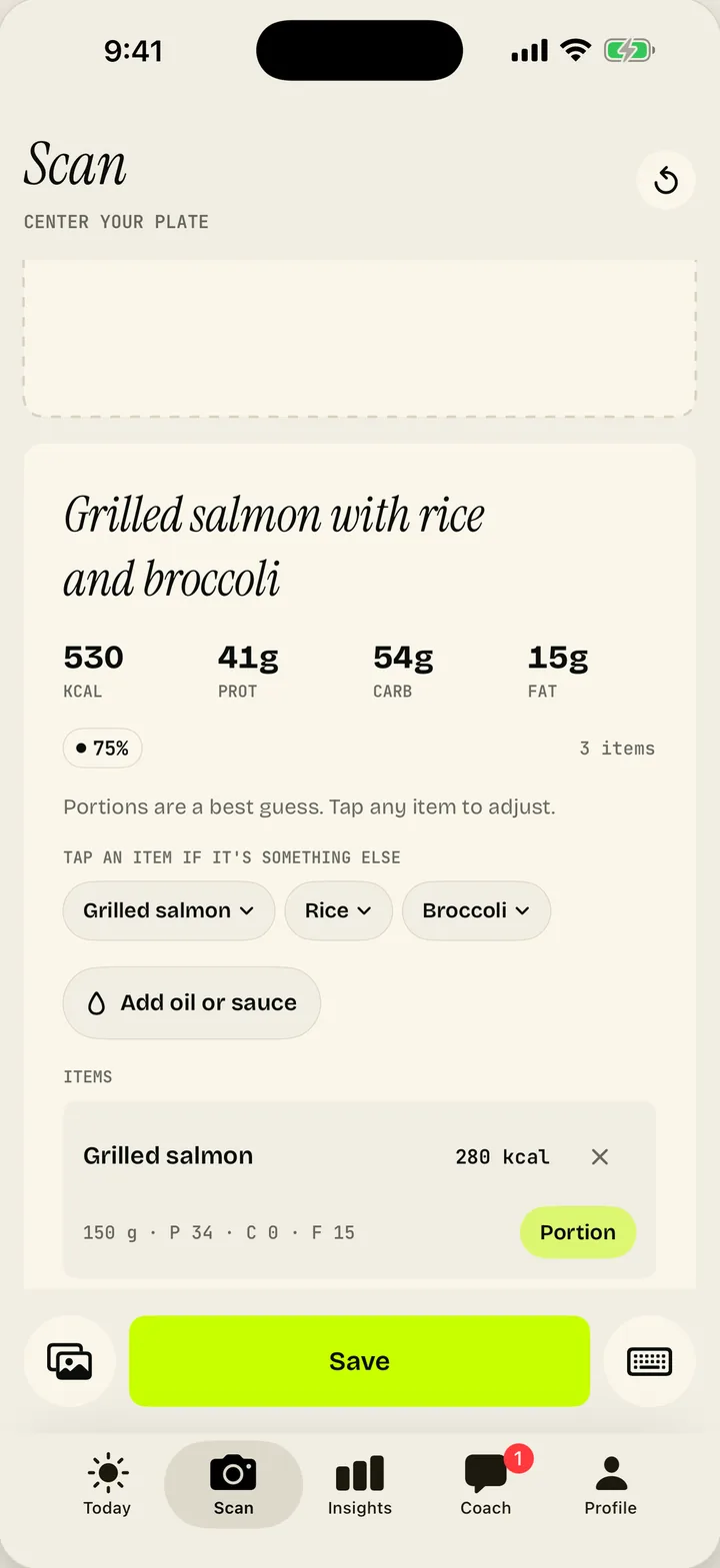
SnapMacro uses a calorie target based on the standard formulas and then updates it using your logged intake and your real weight trend, rather than relying on a fixed 3,500 rule. The weekly view smooths daily noise. Photo logging is approximate, and every entry is editable, so check unusual numbers. If you want a calmer approach, the app also offers a single-ring view without streaks. See losing weight without obsessing.
General information only, not medical advice. SnapMacro is not a medical device. Talk to a clinician or registered dietitian before starting a weight-loss plan if you have a medical condition.
Sources
- Thomas DM, Martin CK, Lettieri S, et al. Can a weight loss of one pound a week be achieved with a 3500-kcal deficit? Commentary on a commonly accepted rule. Int J Obes. 2013;37(12):1611-1613. PubMed
- Hall KD, Sacks G, Chandramohan D, et al. Quantification of the effect of energy imbalance on bodyweight. Lancet. 2011;378(9793):826-837. PubMed
- NIDDK. Body Weight Planner. niddk.nih.gov/bwp
- Fothergill E, Guo J, Howard L, et al. Persistent metabolic adaptation 6 years after "The Biggest Loser" competition. Obesity. 2016;24(8):1612-1619. PubMed
- Nutritional priorities to support GLP-1 therapy for obesity: a joint advisory. 2025. PubMed Central
SnapMacro
Skip the counting
Snap a photo of a meal and SnapMacro estimates the calories and macros. Every item is editable, and your targets adapt to your real weight trend.
Download on the App Store