How much protein per day?
Key points
- The official minimum for most adults is 0.8 g of protein per kg of body weight per day. It is a floor to prevent deficiency, not an optimum for every goal.
- Published ranges for people who exercise are higher: about 1.4 to 2.0 g/kg per day for those who train.
- When losing weight, ranges around 1.2 to 1.6 g/kg per day have been proposed to help protect lean mass.
- Older adults are advised to eat at least 1.0 to 1.2 g/kg per day, and more if active or unwell.
- People with kidney disease may need to limit protein. Ask a clinician before raising yours.
"How much protein do I need?" has several defensible answers, because the right figure depends on what you are trying to do. Below we separate the ranges by goal, show the arithmetic, and say where the evidence is thinner than the internet suggests.
Start with the minimum: 0.8 g/kg
The Recommended Dietary Allowance (RDA) for protein for adults is 0.8 g per kilogram of body weight per day, set by the US National Academies in their Dietary Reference Intakes. The same report gives an Acceptable Macronutrient Distribution Range of 10 to 35 percent of calories from protein. The RDA is designed to meet the needs of nearly all healthy people to avoid deficiency. It was not designed to maximise muscle, to protect lean mass in a diet, or to support healthy ageing, which is why sports and clinical bodies publish higher ranges for those situations.
Protein ranges by goal
| Goal | Range (g per kg per day) | Source |
|---|---|---|
| General adult minimum (RDA) | 0.8 | National Academies DRI |
| Active or lifting, to build or keep muscle | 1.4 to 2.0 | ISSN position stand, 2017 |
| Active weight loss | 1.2 to 1.6 (proposed) | Cited in the 2025 joint advisory on GLP-1 nutrition |
| Adults over 65, healthy | 1.0 to 1.2 (at least) | PROT-AGE study group, 2013 |
| Adults over 65, exercising | 1.2 or more | PROT-AGE study group, 2013 |
| Adults over 65 with acute or chronic illness | 1.2 to 1.5 | PROT-AGE study group, 2013 |
If you lift weights
The International Society of Sports Nutrition concluded that 1.4 to 2.0 g/kg per day is sufficient for most exercising people to build and maintain muscle. A meta-analysis of 49 trials found that protein supplementation produced small average gains in strength and muscle size during resistance training, and that benefits levelled off at total intakes of about 1.62 g/kg per day (Morton et al., 2018). The practical reading is that going beyond roughly 1.6 g/kg is unlikely to build much more muscle for most lifters, though a higher figure can be a convenient buffer when you are unsure about your logging. See our guide for lifters.
If you are losing weight
When calories fall, some of the weight lost is lean tissue. Reviews of higher-protein, calorie-restricted diets report greater fat loss and better preservation of lean mass than lower-protein diets (Leidy et al., 2015). The 2025 joint advisory on nutrition during GLP-1 therapy notes that targets of 1.2 to 1.6 g/kg per day have been proposed during active weight reduction, and that for people with obesity it is unclear whether to base the figure on actual weight, an adjusted weight, or fat-free mass. Using actual weight can overstate the need at higher body weights. It also describes setting an absolute target of 80 to 120 g per day as one way to keep things simple. Resistance training matters here as much as protein. See eating enough protein on a GLP-1 medication and the weight-loss guide.
If you are over 65
The PROT-AGE study group, an international group of geriatric and nutrition researchers, recommends that older adults average at least 1.0 to 1.2 g/kg per day to maintain and regain lean mass and function, with 1.2 g/kg or more for those who exercise, and 1.2 to 1.5 g/kg for most people with acute or chronic disease. The exception is severe kidney disease (estimated GFR below 30 mL/min/1.73 m2) in people not on dialysis, who may need to limit protein. If you have any kidney condition, take the numbers in this article to your clinician rather than applying them yourself.
Worked examples
| Person | Goal | Calculation | Daily protein |
|---|---|---|---|
| 70 kg adult | Minimum | 70 x 0.8 | 56 g |
| 70 kg adult | Lifting | 70 x 1.6 | 112 g |
| 90 kg adult | Weight loss | 90 x 1.2 to 1.6 | 108 to 144 g |
| 68 kg adult over 65 | Healthy, active | 68 x 1.2 | about 82 g |
These are arithmetic illustrations of published ranges, not prescriptions. The protein calculator does the sums for you.
Spreading protein across the day
Protein distribution is a smaller lever than total intake, but it is practical. A review by Schoenfeld and Aragon concluded that, to maximise muscle building, a target of about 0.4 g/kg per meal across at least four meals reaches roughly 1.6 g/kg per day. For a 70 kg person that is about 28 g per meal. Many people eat most protein at dinner; moving 20 to 30 g to breakfast is often the easiest change.
What does 30 g of protein look like?
Using USDA FoodData Central values, approximately: 3 oz (85 g) of roasted chicken breast has about 26 g; a 3 oz serving of canned pink salmon has about 20 g; three-quarters of a cup of plain nonfat Greek yogurt has about 17 g; two large eggs about 13 g. For a longer list with calories, see 25 high-protein snacks.
Is more always better?
For healthy adults, intakes in the ranges above are considered safe, but evidence for benefits flattens out and total calorie needs still apply. The 2025 joint advisory cautions that prolonged intakes at or above 2 g/kg per day should be avoided in the setting it addresses, and that intakes below 0.4 to 0.5 g/kg per day can lead to muscle loss. People with kidney disease, and anyone advised by a clinician to limit protein, should follow that advice instead.
How SnapMacro helps
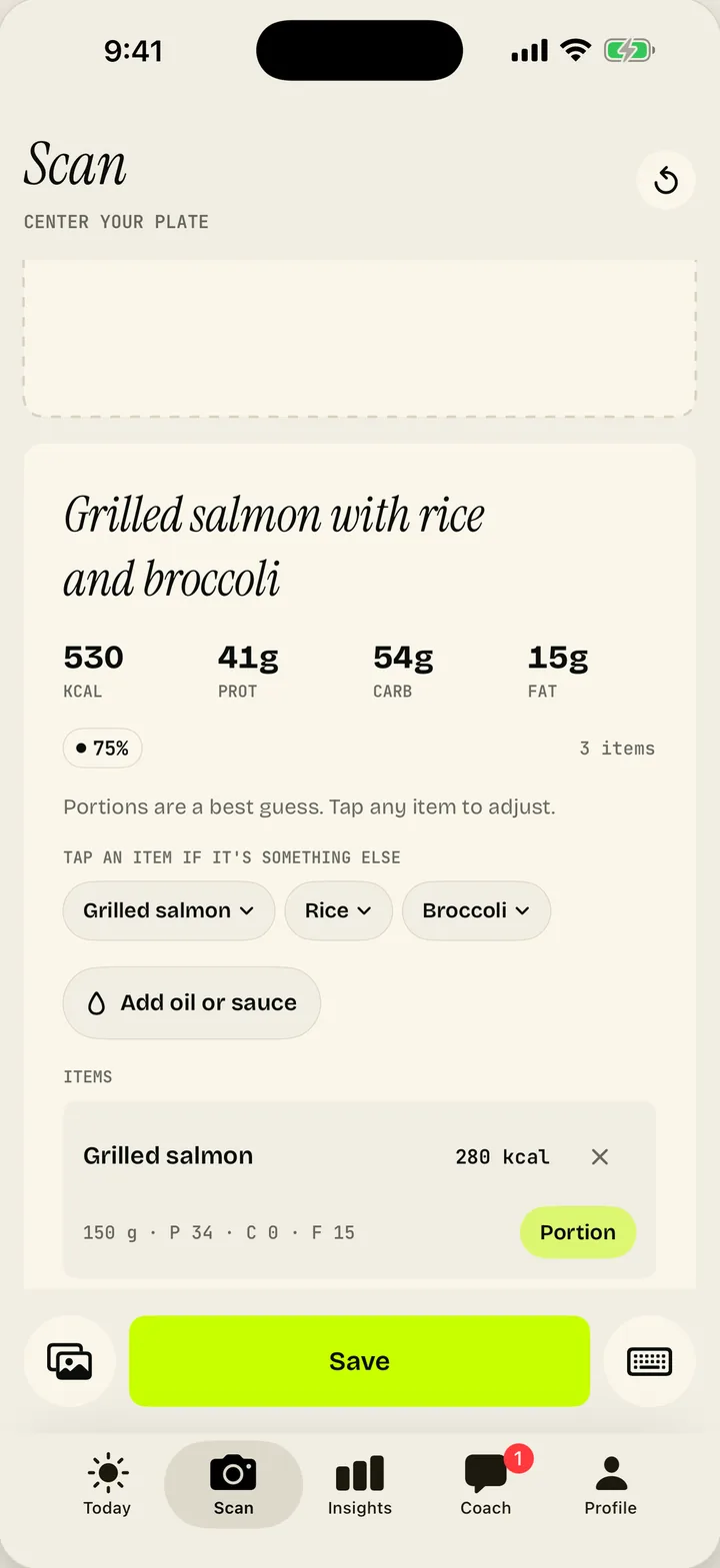
SnapMacro sets a starting protein target from your goal and body weight, shows protein as its own ring so it is visible during the day, and lets you adjust the target. In the GLP-1 and athlete setups the app puts protein first. Photo and text logging estimate protein per item, and every item is editable. These are estimates, and protein from mixed dishes is among the harder things for a camera to judge, as explained on the accuracy page.
This article is general information, not medical advice. SnapMacro is not a medical device. Talk to a clinician or registered dietitian about your own needs, particularly if you have kidney disease or take medication.
Sources
- National Academies. Dietary Reference Intakes for Energy, Carbohydrate, Fiber, Fat, Fatty Acids, Cholesterol, Protein, and Amino Acids. 2005. nap.nationalacademies.org
- Jager R, Kerksick CM, Campbell BI, et al. International Society of Sports Nutrition Position Stand: protein and exercise. J Int Soc Sports Nutr. 2017;14:20. PubMed
- Morton RW, Murphy KT, McKellar SR, et al. A systematic review, meta-analysis and meta-regression of the effect of protein supplementation on resistance training-induced gains in muscle mass and strength in healthy adults. Br J Sports Med. 2018;52(6):376-384. PubMed
- Bauer J, Biolo G, Cederholm T, et al. Evidence-based recommendations for optimal dietary protein intake in older people: a position paper from the PROT-AGE Study Group. J Am Med Dir Assoc. 2013;14(8):542-559. PubMed
- Leidy HJ, Clifton PM, Astrup A, et al. The role of protein in weight loss and maintenance. Am J Clin Nutr. 2015;101(6):1320S-1329S. PubMed
- Schoenfeld BJ, Aragon AA. How much protein can the body use in a single meal for muscle-building? Implications for daily protein distribution. J Int Soc Sports Nutr. 2018;15:10. PubMed
- Nutritional priorities to support GLP-1 therapy for obesity: a joint advisory from the American College of Lifestyle Medicine, the American Society for Nutrition, the Obesity Medicine Association, and The Obesity Society. 2025. PubMed Central
- USDA FoodData Central. fdc.nal.usda.gov
SnapMacro
Skip the counting
Snap a photo of a meal and SnapMacro estimates the calories and macros. Every item is editable, and your targets adapt to your real weight trend.
Download on the App Store